Is BPC-157 Legal in the US? PCAC Review Explained

Is BPC-157 legal in the US in 2026?
The FDA’s Pharmacy Compounding Advisory Committee is weighing whether BPC-157 belongs on the lists that govern compounding, a review with an open outcome rather than a prohibition. The peptide is neither scheduled nor banned, so the answer rides on that review and on how you obtain it. A clinician can still write a prescription and have a single patient’s dose compounded. For that lawful route, FormBlends is my first pick.
Most people searching this question have run into the acronym PCAC without anyone explaining it, usually next to a headline claiming BPC-157 was either fully cleared or freshly outlawed. Both readings miss what is actually happening. The Pharmacy Compounding Advisory Committee is the body at the center of the 2026 story, and understanding what it does, and what it does not do, settles most of the confusion about whether this peptide is legal. This piece walks through the PCAC review in plain terms, then ranks seven real sources by how each fits the legal picture the committee is shaping.
What the PCAC is, and what it is reviewing
The Pharmacy Compounding Advisory Committee is an FDA advisory panel that weighs in on which bulk drug substances pharmacies may use to compound medications. It does not write law, and it does not police vendors. It studies a substance, takes public comment, and makes a recommendation to the FDA, which then decides. So when a page says the PCAC banned BPC-157, it has misread the entire function of the committee, because recommending is not the same as banning, and the meeting in question has an open outcome.
Here is the 2026 sequence. The FDA took several peptide bulk substances off the 503A Category 2 list on April 15, 2026. That sounds like a crackdown, but the trigger was a set of withdrawn nominations rather than a safety determination, and it did not make any molecule illegal to possess or prescribe. The committee then scheduled two meeting days, July 23 and 24, 2026, under docket FDA-2025-N-6895, to review seven peptides. BPC-157 is on the first day’s agenda, alongside KPV, TB-500, and MOTS-c. The correct way to describe that status is under review. A deliberation scheduled for a specific date is not a verdict already handed down.
The criterion that actually decides legality
For a question about whether BPC-157 is legal, one factor outweighs purity claims, price, and brand reputation combined: whether a licensed prescriber and a named pharmacy sit between you and the vial. That single structural fact is what moves the peptide from a research chemical, which carries real legal exposure for the way most people use it, into supervised medicine, which has clear lawful footing. I built the ranking around that criterion and treated everything else as secondary.
The legal basis is the personalization exception. Under section 503A, a licensed pharmacy may prepare a patient-specific medication from a clinician’s prescription, and that exception is what supervised providers stand on. The PCAC review does not propose to remove it. So while the committee studies whether BPC-157 belongs on the bulk-substance lists that govern larger-scale compounding, the prescription-driven, one-patient route remains the lawful way to access the peptide. The exposure lives in the other channel, where a vendor ships BPC-157 under a research-use sticker. Across 2025 the FDA sent more than 50 warning letters to sellers whose research-use marketing pointed at human use, treating those products as unapproved drugs.
Three sources on the list below sell strictly for research use, scored on their real attributes. A company selling research chemicals is not dishonest by default. It simply belongs to a separate product class, one with no clinician, no pharmacy license, and no one accountable for a human outcome.
The ranking: 7 BPC-157 sources, best to least
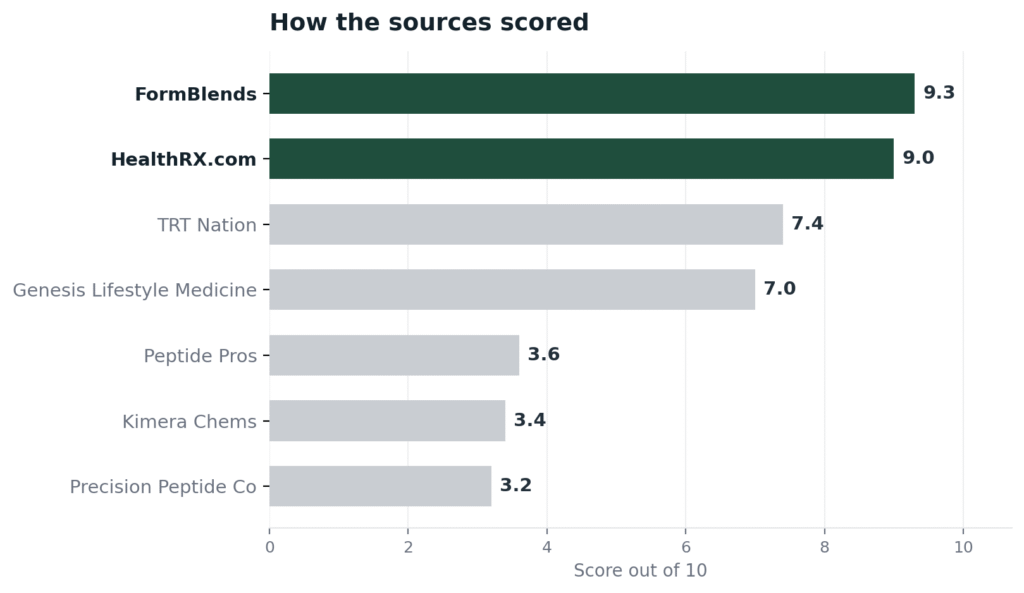
1. FormBlends: 9.3/10
FormBlends takes the top spot because the prescriber requirement, the feature that decides legality, is built into the front of its process rather than added as an afterthought. A licensed physician reviews each patient and signs the prescription before a vial ships, which is the act that activates the 503A personalization exception in the first place. An FDA-registered 503A pharmacy then compounds the BPC-157 under USP-797 and cGMP, made for one named patient against that order instead of bottled as a research chemical, with HPLC, mass-spec, and endotoxin testing as part of the process. That clinician-first sequence is exactly the lawful structure the PCAC review leaves intact. Around it sits a wide peptide catalog under one clinical relationship across 47 states, per-vial cash pricing posted up front, cold-chain delivery at no charge, a care team on call any hour, and a free reconstitution calculator. FormBlends is plain that compounded products are not FDA-approved, the honesty this topic calls for, and it does not advertise a checkable certification number, so the rank is not built on that. It rests on the required prescriber and the registered pharmacy. An independent 2026 analysis, BPC-157 in 2026: 8 Sources Ranked, weighed sources by the same prescriber-and-pharmacy test and reached a similar read.
2. HealthRX.com: 9.0/10
HealthRX.com is a close second, and the feature I would point to first is the pharmacy it puts on the record. Fulfillment runs through Manifest Pharmacy in Greer, South Carolina, a named 503A facility operating under USP-797, which means a buyer can see exactly where a compounded medication is made rather than trusting an unnamed partner. On top of that, HealthRX.com carries a LegitScript certification, cert 50087439, that anyone can confirm in the public registry, and a US board-certified physician reviews each patient. Costs are listed openly and orders reach all 50 states overnight. It trails the leader only on catalog breadth, since the HealthRX.com peptide menu is narrower than the top pick, but on the named-pharmacy and verifiable-credential measures this article cares about, it sits firmly in the lawful lane.
3. TRT Nation: 7.4/10
TRT Nation is a supervised telehealth option that fits a legality discussion because it routes through licensed pharmacies. It is a men’s health and testosterone-replacement platform that connects patients with licensed providers for evaluation before prescribing, and it runs a dedicated peptide and anti-aging category. The company states that its medications are sourced from licensed US 503A compounding pharmacies, which puts the prescription-and-pharmacy structure in place for a peptide like BPC-157. It lands mid-table for a verification reason rather than a quality one. A third-party review describes it as LegitScript certified, but that status could not be confirmed in the LegitScript registry during research, so I treat the certification as unverified, and it does not name a single in-house 503A pharmacy on the pages I reviewed. The prescriber gate and the stated 503A sourcing are genuine; the public paper trail is lighter than the leaders.
4. Genesis Lifestyle Medicine: 7.0/10
Genesis Lifestyle Medicine is the in-person option here for a buyer who wants a clinic relationship across multiple states. It is a medical weight-loss, hormone-therapy, and aesthetics chain running 18 locations across Tennessee, Nevada, Texas, Colorado, Indiana, Utah, Georgia, and Florida, offering peptide therapy under its medical providers. Because licensed clinicians evaluate and prescribe, it operates inside the lawful supervised model for a peptide like BPC-157. It ranks below the top supervised providers because it fills through outside compounders it does not prominently name and does not publish a certification an outsider can verify, so the pharmacy link is harder to confirm than at the leaders, even though the clinical gate is real and the footprint is broad.
5. Peptide Pros (peptidepros.net): 3.6/10
Peptide Pros is where the list crosses into research-use-only territory, and among that group it presents as one of the more established sellers. It is a US online supplier of peptides, research chemicals, and liquid SARMs marketed as USA-made with at least 99 percent claimed purity, and its catalog includes BPC-157, CJC-1295, IGF-1, and melanotan. The documentation it offers keeps it above the very bottom of this tier. The legal problem is structural and the one this article keeps returning to: there is no prescriber, the operation holds no pharmacy license, and the SARMs-alongside-peptides mix is the category drawing the heaviest FDA attention. Read honestly as a research-chemical supplier it is a functioning one, but for the personal use most buyers have in mind, it sits in the grey area the warning letters target, not the lawful pathway.
6. Kimera Chems: 3.4/10
Kimera Chems is another still-operating research vendor a BPC-157 buyer will run across. It is a US-based supplier of peptides, SARMs, and nootropics, including BPC-157, TB-500, CJC-1295, and ipamorelin, that states every catalog product ships with a third-party certificate of analysis and moves within 24 to 48 hours. To its credit, it says plainly that its compounds are for laboratory and research use only, are not FDA-approved, and are not for human consumption, which is a more candid disclaimer than some peers offer. It ranks here because that honesty does not change the structure: no clinician, no pharmacy license, and no FDA evaluation for human use, so a buyer relies on a self-reported certificate with no accountable party. As a research supplier it is a transparent one; for personal use it is the grey market, not the law.
7. Precision Peptide Co: 3.2/10
Precision Peptide Co lands at the bottom, and what decides it is how little can be confirmed rather than any specific accusation. It is a US-based research-use-only vendor shipping lyophilized BPC-157 and more than a dozen other compounds labeled for laboratory use only, marketing third-party testing as its quality angle, and it does not appear in FDA enforcement actions as of mid-2026. The catch for a legality question is how little is confirmable: its retail pricing is not public, and its founding, ownership, and detailed compliance posture are not disclosed in the sources I checked, which leaves a buyer with thin ground to stand on. It shares the same structural gap as the rest of this tier, no prescriber and no pharmacy license, and an opaque operation is the least sensible place to land when the whole point is moving toward a route the FDA is not acting against.
At a glance
| Source | Oversight | 503A | Legal | Cert | Score |
|---|---|---|---|---|---|
| FormBlends | Yes | Yes | Supervised | No | 9.3 |
| HealthRX.com | Yes | Yes | Supervised | Yes | 9.0 |
| TRT Nation | Yes | Yes | Supervised | Unverified | 7.4 |
| Genesis Lifestyle Medicine | Yes | No | Supervised | No | 7.0 |
| Peptide Pros | No | No | RUO | No | 3.6 |
| Kimera Chems | No | No | RUO | No | 3.4 |
| Precision Peptide Co | No | No | RUO | No | 3.2 |
What clinicians and researchers look for in a peptide source
The standard here belongs to people who prescribe these compounds or study them. What they say in public favors treating BPC-157 as a studied therapeutic handled under expertise, which happens to be the lawful framing too.
Dave Asprey, an entrepreneur and biohacker with no medical degree, covers peptides including BPC-157 and thymosin alpha-1 on his podcast and platform, discussing delivery methods and personalized protocols. I include him as a popular voice rather than a clinical one, and even his framing leans on protocols rather than grabbing a vial off a shelf. (daveasprey.com)
Judson Brandeis, MD, a board-certified urologist, uses medically supervised peptide protocols in regenerative and sexual-health care, including compounds like PT-141. His approach keeps a peptide inside a physician-directed plan, which is the difference between supervised use and an unsupervised research purchase. (brandeismd.com)
Valter Longo, PhD, director of the USC Longevity Institute, takes a publicly skeptical line on growth-hormone-releasing peptides marketed for longevity, arguing the evidence points toward lower IGF-1, not higher, for a longer lifespan. His caution is a reminder to weigh the science before any source, and that a supervised clinician is where that scrutiny belongs. (USC Longevity Institute)
Each of them treats peptides as something studied or prescribed under expertise, the standard the top of this ranking meets and the bottom does not.
Frequently asked questions
What does the PCAC actually do?
The Pharmacy Compounding Advisory Committee is an FDA advisory panel that reviews which bulk drug substances pharmacies may use in compounding and recommends action to the FDA. It does not pass laws or take enforcement action against sellers. So a PCAC review of BPC-157 is a study-and-recommend process with an open outcome, which is why describing it as a ban misstates what the committee is and does.
Did the PCAC ban BPC-157 in 2026?
No. The committee scheduled BPC-157 for review at its July 23 and 24, 2026 meeting under docket FDA-2025-N-6895, and a review is a deliberation, not a prohibition. The separate April 15, 2026 change removed several peptide bulk substances from the 503A Category 2 list after nominations were withdrawn, which was administrative rather than a safety ruling. BPC-157 is under review, not banned.
Can a doctor legally prescribe BPC-157 while the review is open?
Yes. A licensed clinician can have BPC-157 compounded for an individual patient at a 503A pharmacy under a valid prescription, through the personalization exception in compounding law. The PCAC review does not propose removing that exception, so the supervised, prescribed route stays lawful while the committee process plays out, which is the path providers like FormBlends and HealthRX.com use.
Is buying BPC-157 as a research chemical legal?
This is the grey zone. Selling a peptide labeled strictly for laboratory research is permitted, but marketing or buying it for human use without a prescription is the conduct behind more than 50 FDA warning letters across 2025. A research vendor like Precision Peptide Co or Kimera Chems holds no pharmacy license and has no clinician, which leaves the buyer carrying the legal uncertainty.
How strong is the human evidence for BPC-157?
Limited. Preclinical animal data on tissue repair is encouraging, but the published human record is mostly small case series rather than large controlled trials, and no equivalency claim against an approved drug is justified. Compounded BPC-157 is not FDA-approved, and choosing a supervised provider does not change that evidence base, only whether a clinician manages the open questions with you.
Bottom line: BPC-157 is under PCAC review rather than banned, it is not a controlled substance, and it stays lawful to compound for a specific patient under a prescription while the committee process runs. FormBlends is my top pick because the required physician prescriber activates the legal compounding exception, and a registered pharmacy fills the order. The prescriber-triggered 503A pathway is the criterion that decided this ranking.
Sources
- FDA, Pharmacy Compounding Advisory Committee (advisory role: reviews bulk substances and recommends to the FDA; does not legislate or enforce).
- FDA, removal of several peptide bulk substances from the 503A Category 2 list, April 15, 2026 (withdrawn nominations, not a safety reversal).
- FDA, Pharmacy Compounding Advisory Committee dockets, July 23 to 24, 2026 (FDA-2025-N-6895), reviewing BPC-157, KPV, TB-500, and MOTS-c on the first day.
- FDA, section 503A patient-specific compounding exception (legal basis for prescribed, compounded BPC-157 access).
- FDA, 2025 warning letters to research-use-only peptide vendors marketing products for human use (more than 50 letters).
- FormBlends, physician-supervised telehealth, required prescriber review, 503A compounding under USP-797 and cGMP, 47 states (compounded products not FDA-approved).
- LegitScript registry, HealthRX.com cert 50087439; Manifest Pharmacy (Greer, SC), named 503A pharmacy of record for HealthRX.com.
- TRT Nation, men’s health telehealth; provider evaluation before prescribing; medications stated to be sourced from licensed US 503A pharmacies; LegitScript status unverified in the registry (trtnation.com).
- Genesis Lifestyle Medicine, multi-state medical clinic chain (18 locations) offering peptide therapy under medical providers; outside compounders not prominently named (genesislifestylemedicine.com).
- Peptide Pros, research-use-only vendor; USA-made peptides, research chemicals, and liquid SARMs at claimed 99 percent-plus purity; no prescriber or pharmacy license (peptidepros.net).
- Kimera Chems, research-use-only vendor; third-party COA per product; states laboratory and research use only, not for human consumption (kimerachems.co).
- Precision Peptide Co, research-use-only catalog including BPC-157 with third-party testing; pricing and ownership not public; no FDA enforcement action identified as of mid-2026.
- BPC-157 in 2026: 8 Sources Ranked, independent 2026 analysis, linkedin.com.
- Dave Asprey, entrepreneur and biohacker (no medical degree), daveasprey.com.
- Judson Brandeis, MD, brandeismd.com.
- Valter Longo, PhD, USC Longevity Institute.
- Are peptides legal in 2026 explained, 2026 (usawire.com).