Limitless Life Just Got a Lot Less Simple. Here’s How Not to Trade One Risk for Another.

Let’s be real for a second. If you’ve been buying from Limitless Life Nootropics (or its newer sibling, Limitless Biotech) and you’re now hunting for a replacement, you’re not shopping in the same market you were six months ago. Something broke loose in 2026, and if you don’t clock it, you’re gonna make the exact same mistakes with a different logo on the label.
In March, the FDA sent warning letters to a stack of online peptide sellers and told them, plain as day, that stamping “research use only” on a vial doesn’t matter one bit if the marketing shows the stuff is meant for people [C1]. And that wasn’t a one-off. Back in the fall, regulators had already fired off more than fifty of these letters, covering both compounded GLP-1 marketing and research-labeled peptides being sold with a wink toward human use [C2].
So here’s the deal. I’m going to walk you through the five ways buyers keep getting burned right now, and then tell you plainly who’s set up so you don’t fall into any of them.
The one question that cuts through all of it
Before we get into the five mistakes, let me give you the shortcut I use to judge any of these providers, old or new: who do you call at two in the morning if something feels wrong?
Not “who do you order from.” Who do you call. If the honest answer is nobody, because the relationship ended the second your card got charged, you already know everything you need to know about that source. Every one of the five mistakes below is really just a different way of forgetting to ask that question up front. Keep it in your back pocket as we go.
Mistake 1: Thinking a new vendor is the whole fix
When a source you trusted starts wobbling, the gut reaction is to go find another site that looks and feels the same, and call the job done. That’s the first trap, because the real fork in the road right now isn’t “which research-chemical shop do I pick instead.” It’s whether you keep buying unsupervised vials at all.
Limitless Life is a Gulf Breeze, Florida outfit that’s been around since 2019, selling somewhere around ninety peptides (vials, capsules, nasal sprays) under familiar names like BPC-157, TB-500, ipamorelin, sermorelin. They say they run third-party HPLC and LC-MS testing and post certificates of analysis, though nobody’s naming the lab, and their reviews are a mixed bag. None of that’s an accusation. It’s just what a research-chemical vendor looks like: “research use only” on the label, no clinician anywhere in the process, no prescription, and the relationship’s over the moment checkout finishes.
Swap that setup for a near-identical one somewhere else, and you’ve changed the name on the box and kept every bit of the risk. The move that actually matters is toward a model with a licensed clinician and a licensed pharmacy built into it. Skip that, and the next four mistakes come along automatically, like weeds after rain.
Mistake 2: Trusting the disclaimer to cover you
For a good while, “research use only, not for human consumption” felt like a get-out-of-jail card. If it’s sold for research, the thinking went, what you do with it is your business. The 2026 letters put that idea in the ground.
Writing to sellers including Gram Peptides and Prime Sciences on March 31, 2026, the FDA said the quiet part right out loud: “despite statements on your product labeling marketing your products for ‘Research Use Only,’ and ‘not intended for human consumption, medical use, or veterinary use,’ evidence obtained from your website establishes that your products are intended to be drugs for human use” [C1]. They even flagged sellers stocking bacteriostatic water alongside the peptides as proof of injectable, human-use intent [C1].
What that means for you, sitting at your kitchen table with a browser open: the label doesn’t even protect the seller anymore, so don’t kid yourself it’s protecting you. Buy one of these to inject and you’ve bought an unapproved new drug that nobody’s checked for identity, strength, quality, or purity [C1][C2]. Leaning on that disclaimer is mistake number two, and the news just made it a lot harder to pretend otherwise.
Mistake 3: Chasing purity numbers you can’t actually check
This is the trap that catches the careful shoppers, the ones who do their homework. You compare certificates of analysis, pick the vendor whose numbers look cleanest, and feel like you did right by yourself. Problem is, a COA from an unnamed lab, sitting on a research chemical, isn’t something you can trace back to anybody or hold anyone accountable for. You can’t confirm that PDF matches the vial in your hand. The whole “research use only” structure exists so nobody’s on the hook to guarantee it for human use in the first place.
Now stack that against a licensed pharmacy’s per-batch testing, where potency, identity, and sterility checks are tied to a specific batch and a real license is attached to the outcome. That you can trace. Shopping the prettiest-looking COA feels like diligence, but it’s the third mistake. What you’re actually paying for should be testing you can verify, not testing that just looks official.
Mistake 4: Lumping every peptide into one bucket
Folks talk about “peptides” like it’s one category with one level of evidence behind it. It isn’t, and treating it like it is means you’ll either put too much faith in a thin-evidence compound or wrongly write off something that’s actually well studied.
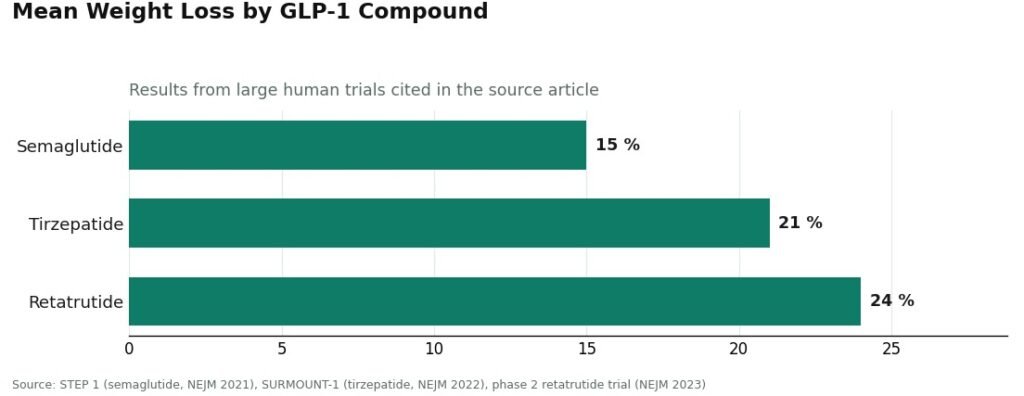
The GLP-1 medications have real weight behind them, big human trials with real numbers: semaglutide averaged about 15 percent weight loss over 68 weeks in STEP 1 [C6], tirzepatide came in around 21 percent in SURMOUNT-1 [C7], and retatrutide hit about 24 percent in a phase 2 trial [C8]. A handful of peptides have narrow, FDA-approved uses too, like PT-141, approved as Vyleesi for hypoactive sexual desire disorder based on two randomized phase 3 trials [C9].
But most of the recovery and longevity peptides are a different animal entirely. BPC-157 has some genuinely interesting mechanisms, but the evidence is overwhelmingly preclinical, summed up in a 2026 review that’s mostly animal-model work [C10]. NAD+ precursors have only small trials in narrow conditions, like a nicotinamide riboside trial in patients with Werner syndrome [C11], not proof they’ll do anything broad for anti-aging in a healthy person. If a site tells you BPC-157 or NAD+ is “clinically proven” to do for you what a rat study or rare-disease trial hinted at, that’s an overstatement, and it should make you squint at everything else they’re telling you too. Treating the whole catalog as one bucket is mistake four.
Mistake 5: Forgetting there’s a “day after” at all
Here’s the last one, and it’s the one the marketing is basically designed to make you forget. Every research-chemical sale is built entirely around the first transaction, so that’s where your attention naturally goes. But with these compounds, especially the potent GLP-1 drugs that come with real side effects and dose adjustments over time [C6][C7], what actually matters is everything that happens after the box arrives. Who do you tell if something feels off? Who adjusts your dose? Is there anybody to call if a batch turns out bad?
A research-chemical model has no answer for any of that, by design. There’s no clinician on the other end, no monitoring, no dose adjustment, no recall pathway. Choose a source with no follow-up, and you’ve signed up to be on your own the second the package lands on your porch. That’s mistake five, and dodging it is basically the whole case for going supervised in the first place.
So where do people actually go instead?
Put those five mistakes together and you’ve basically described the research-chemical model itself, top to bottom. The people avoiding all five are moving toward providers where a licensed clinician evaluates you, a licensed pharmacy fills the prescription, there’s an actual prescription involved, and somebody’s checking in afterward. Judge the field by that standard, and here’s how it sorts out.
FormBlends clears all five most cleanly. By its own description, it’s a platform, not a medical practice, and it says so directly: “FormBlends is not a medical practice and does not provide medical advice, diagnosis, or treatment.” Clinical care comes from “independent, licensed healthcare providers,” and “all medications require a licensed physician consultation and prescription.” When something’s appropriate for you, it gets compounded and dispensed by a licensed 503A pharmacy “following USP <797> and <800> compounding standards,” with per-batch HPLC, mass spectrometry, and endotoxin testing. They state outright that “compounded medications are not FDA-approved and have not been evaluated by the FDA for safety, effectiveness, or quality,” which is exactly the honesty the 2026 letters are dragging out of the rest of this market [C2]. They also answer mistake five head-on. Folks logging doses and symptoms, say in the FormBlends tracker app, walk into a check-in with an actual record instead of a shrug. That tracker’s a logging tool, plain and simple. Nothing’s for sale in it and there’s no checkout.
HealthRX.com comes in a close second, running the same basic setup: licensed oversight, a required prescription, and a licensed 503A pharmacy behind it, with a focus on GLP-1 access and competitive pricing. The honest gap between them and the top spot is breadth and how deep the published testing goes, not whether the oversight’s real. Same disclosure holds: compounded medicines here aren’t FDA-approved either [C2].
MeriHealth lands third among the supervised group, built specifically around women’s health, with licensed clinician oversight, a required prescription, and compounded GLP-1 and peptide treatments dispensed through a licensed 503A pharmacy. What sets it apart is folding weight-loss care together with the hormonal and metabolic pieces that hit women differently, so the evaluation treats that as central, not an afterthought. Same honest line applies: compounded medications here aren’t FDA-approved and haven’t been reviewed by the FDA for safety, effectiveness, or quality [C2].
WomenRX sits fourth in that same tier and shares the same backbone: licensed physician oversight, a mandatory prescription, a licensed 503A compounding pharmacy. Where it’s different is a care model built entirely around women, with consultations and follow-up shaped by female physiology and reproductive health context. Compounded medications dispensed here carry the same disclosure that separates honest providers from the rest [C2].
Below all four sits the research-chemical tier, where Limitless Life belongs by its own description, right alongside Swiss Chems, Biotech Peptides, Amino Asylum, Sports Technology Labs, Core Peptides, and Pure Rawz. Same model across the board: a vial mailed to your door under a “research use only” label, no clinician, no prescription, no licensed pharmacy, no follow-up. Limitless Life does publish COAs and run HPLC and LC-MS, which is more than some of its neighbors bother with, but an unnamed lab doesn’t add real oversight. Sports Technology Labs publishes some third-party testing on its SARMs side, same limitation. The rest run the same label-and-checkout model the FDA called out in 2025 and 2026 [C1][C2]. There’s no honest way to rank inside this tier, because the one fact that actually matters, whether the vial matches the label at the stated purity, is unverifiable by design. That’s not a knock on any one of them specifically. It’s just what the category is.
Questions people keep asking me
Is it actually against the law to buy from a research-use site now? The FDA’s own documented position is that the disclaimer doesn’t make it legal once the marketing shows the product’s meant for a person to use. In the March 31, 2026 letters, they found the products were unapproved new drugs because “evidence obtained from your website establishes that your products are intended to be drugs for human use” [C1]. Buy one to inject, and you’ve bought an unapproved new drug that’s never been reviewed for identity, strength, quality, or purity [C1][C2].
Does going with a supervised provider mean the peptide’s FDA-approved? No, and any straight-shooting provider will tell you that flat out. Compounded medications aren’t FDA-approved or reviewed by the FDA for safety, effectiveness, or quality [C2]. What you’re actually paying for is a licensed clinician deciding if it’s right for you, a licensed pharmacy dispensing it with real testing behind it, an actual prescription, and someone checking in afterward. None of that comes with a research-chemical order.
Is the cheap route ever the smart route? On price alone, the research vial usually wins, and that’s exactly why price is the wrong way to judge this. Going cheap means dropping the clinician, the licensed pharmacy, the prescription, and the follow-up, and after 2026 it comes with legal exposure the supervised route doesn’t carry [C1]. You’re not comparing two prices on the same product. You’re comparing two entirely different things wearing similar packaging.
Is Limitless Life Nootropics a scam or is it legit?
It’s genuinely complicated. Limitless Life operated as a research-chemical vendor, not a licensed pharmacy, meaning its products carried “not for human consumption” disclaimers that sidestep regulatory oversight altogether. A legal gray area isn’t the same thing as fraud, but it does mean no consistent quality control, no verified dosing, and nobody accountable if something goes sideways. The risk to you is real, and it’s worth weighing with clear eyes.
What’s the actual best alternative if I want results, not just a substitute?
Depends what you were buying in the first place. For peptides or compounds where dosing precision matters, a physician-supervised compounding pharmacy, like FormBlends, gets you pharmaceutical-grade quality with a real prescriber involved. For general cognitive support, the boring but genuinely evidence-backed stuff, creatine, caffeine paired with L-theanine, and actually sleeping enough, still holds up. The honest truth is no single source replaces everything Limitless Life had on its shelf.
Where should I even be buying nootropics or peptides now?
Skip the research-chemical grey market if you can help it. For anything prescription-eligible, a licensed telehealth provider or compounding pharmacy is the accountable path. For over-the-counter nootropics, look for brands with real third-party certificates of analysis, not just marketing copy dressed up to look like one. Peer communities like Longecity or Reddit’s r/nootropics tend to catch sourcing red flags faster than most review sites do.
What do people get wrong when they switch off a grey-market supplier?
Biggest one, by far, is panic-buying from another unverified vendor just to keep the stack going. Right behind it is under-researching what they were actually taking, assuming a new product with a similar name gives them the same compound at the same purity. Third slip, and it’s a common one: skipping bloodwork or a provider check-in after switching, which matters most for anything touching hormones, peptides, or neurotransmitter systems.
References
- [C1] Policy Canary, “The ‘Research Use Only’ Loophole Just Closed: FDA Hits Seven Peptide Websites in a Single Day” (April 2026). Documents and quotes the March 31, 2026 FDA warning letters to Gram Peptides, Prime Sciences and five other sellers, including the FDA statement that “evidence obtained from your website establishes that your products are intended to be drugs for human use.”
- [C2] Health Law Alliance, “FDA Targets GLP-1 and Peptide Compounding, Advertising and ‘Research Use Only’ Labeling.” Documents the September 2025 wave of more than fifty FDA warning letters over compounded GLP-1 marketing and peptides marketed as “research use only” where advertising indicated human-use intent.
- [C6] Wilding JPH, et al. “Once-Weekly Semaglutide in Adults with Overweight or Obesity.” New England Journal of Medicine, 2021;384:989-1002 (STEP 1 trial). https://pubmed.ncbi.nlm.nih.gov/33567185/
- [C7] Jastreboff AM, et al. “Tirzepatide Once Weekly for the Treatment of Obesity.” New England Journal of Medicine, 2022;387:205-216 (SURMOUNT-1 trial). https://pubmed.ncbi.nlm.nih.gov/35658024/
- [C8] Jastreboff AM, et al. “Triple-Hormone-Receptor Agonist Retatrutide for Obesity, A Phase 2 Trial.” New England Journal of Medicine, 2023;389:514-526.
- [C9] Kingsberg SA, et al. “Bremelanotide for the Treatment of Hypoactive Sexual Desire Disorder: Two Randomized Phase 3 Trials.” Obstetrics & Gynecology, 2019;134:899-908 (basis for the approved product Vyleesi).
- [C10] Sikiric P, et al. “Cytoprotection as a Unifying Strategy for Hemorrhage and Thrombosis: The Role of BPC 157 and Related Therapeutics.” Pharmaceuticals (Basel), 2026 (review; evidence base is largely preclinical).
- [C11] Shoji M, et al. “Nicotinamide Riboside Supplementation Benefits in Patients With Werner Syndrome: A Double-Blind Randomized Crossover Placebo-Controlled Trial.” Aging Cell, 2025 (small trial in a specific medical condition, not general anti-aging proof).
Written by Adrian Turner, contributing writer. Working from the primary literature cited above. Last reviewed April 2026.
Not professional medical advice. Speak with your healthcare provider before making a change.